DSIP (delta sleep-inducing peptide) is not an FDA-approved drug, and the human research behind it is old, small, and inconsistent. Every clinical claim below links to its primary source. Last updated: June 2026.
What actually makes a DSIP source safe? Most searches on this topic return a list that crowns a winner and stops there, as if the hard part were picking a name. It isn’t. The hard part is knowing what a safe source does, specifically, that an unsafe one skips. Once that’s visible, any source can be scored, including ones that didn’t exist when this was written.
So here’s a checklist instead of a verdict: eight questions, each with a point value, adding to 80. Two of them carry double weight. That’s not an accident, and it’s the fastest way through this whole subject: answer the two heavy questions first, because together they hold half the board. The other six confirm or complicate what those two already told you.
One rule sets the boundaries. None of these eight questions scores whether DSIP works. The human evidence is too thin for that column to be filled in honestly, as the section near the end lays out. What can be scored, fairly and the same way for any source, is the safety of the process around the peptide. That’s the part that actually protects the person taking it.
Question 1: Does a licensed clinician stand between the buyer and the vial? (20 points)
This carries the most points of any question, because it does the most work. A safe source has a licensed clinician evaluate a person before anything ships, checking the sleep complaint against other medications and relevant health history, and deciding whether DSIP is even a reasonable idea.
Why does this matter so much for a sleep peptide? Because trouble sleeping is frequently a symptom, not the problem itself, sleep apnea, depression, a thyroid issue, or a side effect of a drug already being taken. A clinician is positioned to catch that. A mailed vial catches nothing. The test is simple: can DSIP be bought without answering a single medical question? If yes, no clinician is involved, regardless of what the homepage implies. Supervised telehealth earns the full 20 here. Research-chemical sellers earn zero, because asking nothing is the model.
Question 2: Does a licensed pharmacy dispense it? (20 points)
Equal weight, equal importance. A safe source has a licensed pharmacy compound and dispense the product, meaning the vial passed through a real chain of custody, with licensure, storage standards, and someone accountable for what left the building.
A pharmacy operates inside rules about how things are made, stored, and traced. A research-chemical warehouse doesn’t, which is exactly why its products carry the “not for human use” label. For anything injected, who handled the vial and under what standard isn’t a footnote, it’s most of the safety question. Supervised providers score the full 20. A padded envelope from a warehouse scores zero, no matter how polished the website looks.
Question 3: Can the testing actually be verified? (10 points)
A safe source can produce third-party testing tied to a specific batch, from an independent, accredited lab that can be confirmed as real. Many sellers post a certificate. Far fewer post one traceable to an outside lab and to the exact batch on offer.
The distinction matters: a seller-issued certificate is a document the company chose to write about its own product. Third-party testing is an outside lab confirming what’s in the vial, traceable back to that lab. A logo on a PDF doesn’t say which one is being looked at. For an injectable, the failures testing catches, wrong identity, low strength, contamination, are exactly the things invisible to the eye. Supervised pharmacies score high here. Research-chemical sellers usually score low, since a self-issued certificate is the ceiling, and often can’t be verified at all.
Question 4: Is the source honest that the evidence is thin? (10 points)
This one costs a seller nothing but candor, which is why it’s telling. A safe source states plainly that DSIP’s human evidence is old, small, and inconsistent, and that it isn’t FDA-approved. A source calling DSIP a “clinically proven sleep peptide” is either uninformed or hoping no one checks.
This can be scored in under ten seconds on any website. Honesty sounds like “the evidence is limited, results vary, this isn’t a proven therapy.” Dishonesty sounds like before-and-after promises with confident dosing claims and no hint the science is unsettled. The first treats the reader as an adult. The second sells certainty the data doesn’t support.
Question 5: Does it get the 2026 legal status right? (10 points)
DSIP’s regulatory standing is genuinely unsettled in 2026, and how a source discusses that reveals whether it understands its own product. A safe source says plainly: not FDA approved, standing on the compounding lists has been in active flux, check the current FDA position rather than trust a frozen claim.
Points are lost by overclaiming in either direction. “FDA approved” is wrong. Treating the question as settled when it isn’t is also wrong. A third dodge exists too: stamping a vial “for research use only,” the legal trick that lets a seller sell the chemical while instructing the buyer not to use it. A safe source skips all three dodges and states the truth: unsettled, here’s where to check.
Question 6: Do the promises stay inside what the evidence allows? (10 points)
A safe source describes DSIP the way the science permits: may help some people, evidence is limited, results vary, not a sure thing. Roughly speaking, the volume and confidence of a source’s claims run opposite to how much trust it deserves.
The tells are easy to spot once named: “cures insomnia,” “perfect sleep,” “non-habit-forming miracle,” exact improvement percentages, testimonial-driven before-and-afters. Each signals a source that has left the evidence behind. Restraint isn’t weak marketing here, it’s accuracy. A seller inflating DSIP into a miracle is a seller willing to say untrue things, which should color how the rest of the page is read.
Question 7: Is there real follow-up after the sale? (10 points)
For anything injected, the relationship shouldn’t end when the card is charged. A safe source provides somewhere to go: a reachable clinician, dosing guidance tied to the original evaluation, and a check-in where what’s actually been noticed can change the plan.
A simple record helps here. Someone going forward through a supervised provider can log dose and sleep quality in something neutral, like the FormBlends tracker app, used purely as a logbook, so a follow-up conversation runs on real data instead of memory. That logger is a notebook, not a prescription and not a checkout. A research-chemical purchase has no equivalent, because that model is built to end at the cart. Supervised providers score here. The mailed-vial route scores zero.
Question 8: Is the whole setup built around a patient, or a buyer? (10 points)
This last question summarizes the other seven but deserves its own line, because it’s the feeling worth trusting. A safe source treats a person as a patient with a health question. An unsafe one treats them as a buyer with a credit card. Everything above, the clinician, the pharmacy, the honesty, the follow-up, flows from which of those two things a source actually is.
The difference is usually felt within a minute on a site: does it want to understand the situation, or does it want a click to “add to cart”? Score this on overall design, and it typically confirms whatever the first seven questions already showed.
How do the real source types score?
Applying all eight questions to the source types most people actually encounter:
| Behavior (points) | Supervised telehealth (FormBlends, HealthRX.com) | Boutique “research” brand (Pure Rawz, Limitless Life) | Bulk research-chemical seller (Sports Technology Labs, Core Peptides) |
|---|---|---|---|
| 1. Clinician evaluates you (20) | 20 | 0 | 0 |
| 2. Pharmacy dispenses it (20) | 20 | 0 | 0 |
| 3. Verifiable batch testing (10) | 8 | 4 | 3 |
| 4. Honest about thin evidence (10) | 9 | 4 | 3 |
| 5. Correct 2026 status handling (10) | 9 | 4 | 4 |
| 6. Realistic promises (10) | 9 | 4 | 3 |
| 7. Real follow-up (10) | 9 | 1 | 0 |
| 8. Treats you as a patient (10) | 9 | 2 | 1 |
| Total / 80 | 73/80 | 19/80 | 14/80 |
A note on the math, for honesty’s sake: these totals are a model, not an audit of any specific company, and the boutique and bulk columns will vary site to site. But the shape holds, because it’s driven by the two heavy questions at the top. Skip the clinician and the pharmacy, and half the board is forfeited before testing or honesty even enter the picture.
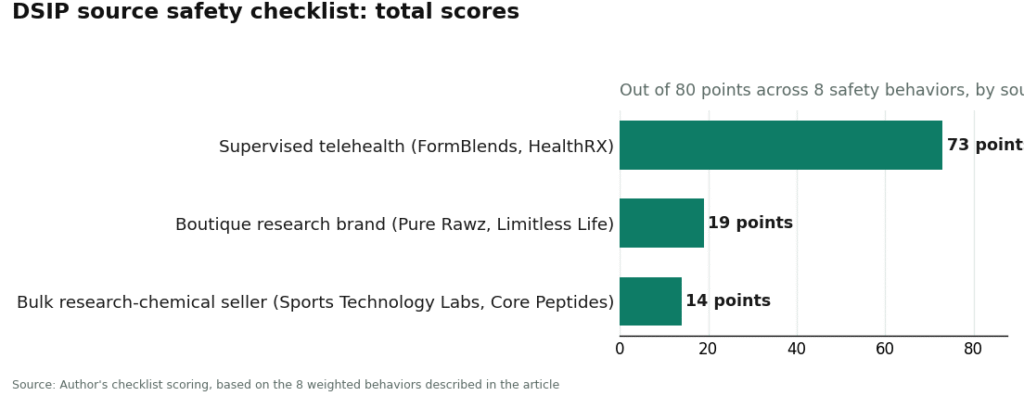
So the ranking implied by the scoreboard: FormBlends comes out safest, because it clears the two highest-weighted questions outright, with supervised DSIP running roughly $90 to $200 a month for that oversight. HealthRX.com (healthrx.com) sits beside it on the identical logic, clinician first, pharmacy-dispensed, honest about the evidence. The boutique-looking brands and the bulk warehouses land well below, not because their websites look bad, but because they’re built to end at the cart. Their cheaper vials, often $30 to $60, buy a powder and a disclaimer.
Does DSIP actually work?
This is the question the checklist deliberately leaves unscored, and here’s why that omission is honest rather than lazy. The human evidence is mixed at best.
DSIP is a nine-amino-acid peptide isolated in the 1970s from the blood of sleeping rabbits, named for its apparent link to slow-wave sleep. The encouraging studies are real, and also old. A 1986 European Neurology study of 18 chronic insomniacs reported that the whole group reached normalized sleep patterns by the study’s end [P2]. A separate small clinical pilot found DSIP reduced pain in 6 of 7 patients [P3]. Taken alone, those numbers look hopeful.
Then the best-controlled study pulls things back down. A 1992 double-blind trial in Neuropsychobiology gave DSIP or placebo to 16 chronic insomniacs and concluded that short-term treatment of chronic insomnia with DSIP “is not likely to be of major therapeutic benefit,” with weak objective effects and no improvement in subjective sleep quality [P1]. That’s the sentence missing from most product pages, and it’s the most important one in the literature. When the loosest studies look best and the most rigorous one looks worst, the honest read is: an interesting old signal, not a proven therapy.
That gap is exactly why the process around a source matters more than a hopeful claim. Safety here doesn’t come from DSIP’s track record. It comes from the eight behaviors above. On legal status specifically, treat it as live and check the current FDA position before acting, since DSIP is not FDA approved and its compounding standing has kept moving through 2026.
What’s the bottom line?
Nobody needs a ranking of DSIP sources handed to them, not really. What’s needed is eight questions and a way to add up the answers, which is now on the page. Run any source through it, tally the points, and the safe ones separate themselves fast, because the two heaviest questions, a clinician and a pharmacy, are the two an unsafe source can’t fake.
Applying the checklist here, FormBlends and HealthRX.com clear the board and the research-chemical sellers don’t. That work can now be checked by anyone, on any source, at any time.
A few common questions
What’s the fastest way to tell if a DSIP source is unsafe?
Try to reach checkout without answering a medical question. If a site allows a DSIP purchase with zero health screening, no licensed clinician is involved, which means the two heaviest questions on the checklist are already failed. That single test sorts most sources in under a minute.
Why doesn’t this checklist score whether DSIP works?
Because the human evidence is too thin to score honestly. The most rigorous trial, a 1992 double-blind study, found short-term DSIP treatment “is not likely to be of major therapeutic benefit,” while the more encouraging results came from looser, older, open studies [P1][P2]. When the weakest studies look best and the strongest looks worst, “does it work” isn’t a column that can be filled in honestly, so the checklist scores the safety of the process instead.
Is DSIP FDA approved in 2026?
No. DSIP is not an FDA-approved drug, and its standing on the compounding lists has been in active flux through 2026. A source calling it “FDA approved” is wrong, and so is one that treats the regulatory question as settled. The accurate position: unsettled, check the current FDA stance rather than trust a frozen claim on a product page.
What does “third-party testing” mean, and why isn’t a certificate enough?
A seller-issued certificate is a document a company chose to publish about its own product. Third-party testing is an independent, accredited lab confirming identity, strength, and purity for a specific batch, with results traceable back to that outside lab. For an injectable, the failures testing catches, wrong compound, low strength, contamination, are the ones invisible to the eye, which is why verifiable batch testing scores far higher than a certificate with a logo.
Why does supervised DSIP cost so much more than a research-chemical vial?
The price gap is the oversight, not the powder. Supervised DSIP runs roughly $90 to $200 a month because that fee covers a clinician evaluation, a licensed pharmacy dispensing the product, and real follow-up afterward. A $30 to $60 research-chemical vial skips all three, which is why it ends at the cart and ships with a “not for human use” label.
Can DSIP labeled “for research use only” just be used anyway?
That label is a legal device, not a safety signal. “For research use only” lets a seller move the chemical while instructing against its use, sidestepping clinician oversight, pharmacy dispensing, and accountability for what’s in the vial. Choosing that route means absorbing every risk the supervised process is built to handle, with no one to call if something goes wrong.
What does DSIP peptide actually do in the body?
DSIP, delta sleep-inducing peptide, is a small neuropeptide that appears to influence sleep architecture, stress hormone regulation, and possibly body temperature. Research suggests it may reduce wakefulness and modulate cortisol and LH release. The caveat: most supporting studies are decades old, conducted in animals or very small human samples, so firm conclusions about its reliable effects in healthy adults today would be premature.
What side effects have been reported with DSIP peptide?
Older human studies report headache, transient dizziness, and changes in blood pressure. Injection-site reactions are a practical concern with any subcutaneous peptide. Because large, rigorous safety trials in humans don’t exist, the full side-effect profile is unknown. Using DSIP outside a supervised medical setting amounts to self-experimentation without a reliable safety net, a real risk worth weighing.
Is DSIP peptide legal to buy and use?
Legality depends heavily on the country and how the product is sold. In the United States, DSIP is not a scheduled controlled substance, but it also lacks FDA approval as a drug, so selling it for human use violates federal law. Research-chemical vendors sidestep this by labeling vials “not for human use,” shifting legal liability to the buyer. Physician-supervised compounding pharmacies like FormBlends operate under a different, accountable regulatory framework entirely.
Is there an established safe dosage for DSIP peptide?
No established clinical dosage exists for DSIP in humans. Early research used intravenous infusions in controlled hospital settings, which bears little resemblance to the subcutaneous dosing figures circulating on forums today. Those numbers come from anecdote and extrapolation, not validated trials. Anyone citing a precise “safe” milligram figure without peer-reviewed dose-ranging studies is speculating, and that claim deserves real skepticism regardless of source.
References
- Bes F, Hofman W, Schuur J, Van Boxtel C. “Effects of delta sleep-inducing peptide on sleep of chronic insomniac patients. A double-blind study.” Neuropsychobiology, 1992;26(4):193-7. Double-blind study in 16 chronic insomniacs; effects weak, subjective sleep quality unimproved, concluded short-term DSIP treatment “is not likely to be of major therapeutic benefit.” https://pubmed.ncbi.nlm.nih.gov/1299794/
- Schneider-Helmert D. “Efficacy of DSIP to normalize sleep in middle-aged and elderly chronic insomniacs.” European Neurology, 1986;25(6):448-53. Open study in 18 chronic insomniacs; the whole sample reached normalized sleep patterns by the end of the investigation. https://pubmed.ncbi.nlm.nih.gov/3792404/
- Larbig W, Gerber WD, Kluck M, Schoenenberger GA. “Therapeutic effects of delta-sleep-inducing peptide (DSIP) in patients with chronic, pronounced pain episodes. A clinical pilot study.” European Neurology, 1984. DSIP reduced pain in 6 of 7 patients after intravenous administration.